All SBPL locations will be CLOSED on Monday, September 7th, for Labor Day. All due dates will be pushed forward. You can access our digital library 24/7.
Vision Zero Santa Barbara
A Smarter Way to Approach Traffic Safety!
Vision Zero is a strategy to eliminate all traffic fatalities and severe injuries in Santa Barbara by 2030 while enhancing safe, healthy, and equitable mobility for all.
Vision Zero is about evolving our thinking about what causes traffic-related collisions and how to prevent them. Traditionally, traffic fatalities and severe injuries have been viewed as “accidents,” yet each traffic-related collision has a cause and can be prevented. Vision Zero regards traffic collisions as a policy problem addressed through focused evaluation, education, engineering, and enforcement.
First implemented in Sweden in the 1990s, Vision Zero has proved successful across Europe and is now gaining momentum in major American cities. The Santa Barbara City Council adopted the Vision Zero perspective in September of 2018 with a target to eliminate all severe and fatal transportation-related collisions by 2030. Read the strategy below!
Traffic Safety Messaging Campaign
Beginning August 2026, the City will release monthly tips to support safer streets. See the latest messages below.
August 2026: Everyone has a role in making our roads safe
Be a good neighbor by caring for all who move along and across Santa Barbara roads.
Stick to the basics of safety!
- Obey traffic laws. Pay attention to road signs and signals.
- Avoid surprises. When crossing or turning, give everyone plenty of space and time to stay out of your way.
- Be patient. Traffic can be frustrating, but patience can make the difference between life and death.
No matter how you get around Santa Barbara, we all have a responsibility to take care of each other, so everyone makes it home safely. Thank you for taking care of your community!
September Campaign: Know the law related to e-bike use
Before your next e-bike ride, familiarize yourself with the laws in Santa Barbara. While most of the rules that govern bicycling are the same for e-bikes, there are some notable enforceable updates that apply to all bicycles and e-conveyances per City Ordinances 10.52.010 through 10.52.080:
Unsafe Riding is Prohibited:
- Bicycles and e-conveyances must be operated safely.
- Unsafe riding includes riding against traffic, speeding, ignoring traffic signs, performing stunts, or failing to yield to pedestrians or vehicles when required.
Youth Violations and Parental Responsibility:
- Minors who violate the ordinance can complete the Council on Alcohol and Drug Abuse’s Youth Diversion Program focused on bicycle and e-conveyance safety.
- If the minor fails to participate, an administrative fine will be issued, and the parent or guardian will be financially responsible.
- If a minor’s unsafe riding causes damage to public property, the City may also pursue reimbursement from the parent or guardian.
Electric Motorcycles (Surrons) are Not E-Bikes:
Electric motorcycles are illegal on all public rights of way.
October Campaign: Don’t let a text turn into a collision
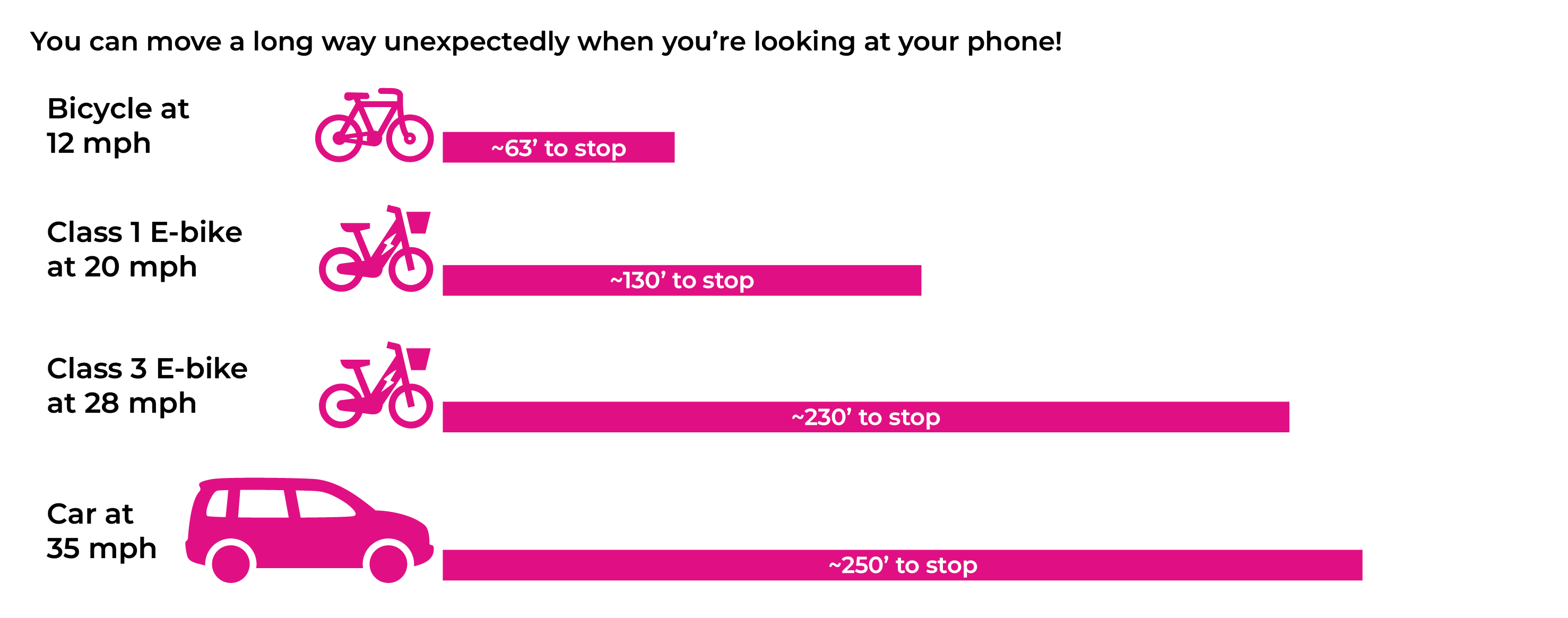
Cell phones are a leading cause of crashes involving distraction. Whether you’re in a car, on an e-bike, or walking, look around, not down. Staying alert prevents crashes and gives you enough time to stop in unexpected circumstances. Put your phone away and keep your eyes, hands, and mind focused on the road.
Stay alert by following these tips:
- Put your phone away, or set it to do not disturb, driving, or airplane mode.
- Plan ahead. Make phone calls, eat, and set up your navigation and music before you start driving.
- Build in breaks every two or three hours for longer trips to check your phone, change your music, or eat.
- Stay focused. Looking away while stopped at a red light delays your reaction to the green light and causes delay for everyone.
Click on the Don’t let a text turn into a collision link to see more information and a graphic on how much you move unexpectedly when you're looking at your phone!
November Campaign: Slow down, save a life
We all have places to be, but it’s better to arrive late than not at all.
The faster you are driving at the point of impact of a crash, the more seriously injured people involved in the crash will be. Slower speeds also give everyone more time to react, which can prevent the crash from happening at all.
How fast you drive matters! Click on the link Slow down, save a life to see a graphic of the probability of a pedestrian surviving a car hitting them at different rates of speed.
December Campaign: Safe streets are sober streets
Every day about 34 people in the United States die in drunk-driving crashes. These deaths are preventable. Operating any vehicle under the influence is irresponsible and illegal. Alcohol, cannabis, and other drugs impair your decision-making and physical reaction times. Bikes and scooters may seem like a safer option, but are just as dangerous as driving while impaired. Plan how you will get home safely, before you consume any alcohol or drugs.
Follow these tips to keep yourself and others safe:
- Use public transportation or carpooling with a designated driver for the group.
- Plan to leave your car or bike overnight.
- Call a sober friend or family member to pick you up.
- Call a taxi or rideshare service.
- Plan to stay over where you are.
If you’re in a situation where a friend who’s drunk or high is trying to leave, please:
- Arrange or provide a ride.
- Offer your couch for the night.
- Arrange for them to stay where they are.
- Engage someone else to help.
Upcoming campaign messages in 2027:
- January: Safety always has the right-of-way
- February: Give yourself a brake
- March: Where you stop can save lives
- April: Speeding narrows your view
- May: Give cyclists space
- June: Keep intersections safe and clear when you park
- July: Park with purpose
- August: Be a friendly e-biker
- September: Avoid crossing confusion: always yield to pedestrians
Safety-First Four E's
A data-driven evaluation of collision statistics involving the Police Department and Public Works transportation professionals. Safety first in this area means we target our limited Public Works and Police Department resources at locations where data analysis indicates collisions are most likely to reoccur.
Enforcement ensures safety laws are known and followed. This section is implemented by the Police Department and other enforcement bodies. The Police Department will report traffic statistics alongside crime statistics as part of its community policing and Vision Zero approach. This means Police Department resources can also be discussed and allocated more appropriately based on safety statistics.
Engineering will anticipate and reduce the effects of human error. This work is done primarily by Public Works transportation professionals. Safety first thinking means resources will be focused on locations with recurring collisions, and designs and plans will be aimed at eliminating collision recurrence.
Education is a public promotion of the safety first mentality. This effort is organized by Public Works and includes marketing strategies and media tools to bring a cultural shift evolving the current thinking about collisions and dangerous driving behaviors and encourages a sense of shared responsibility.
Serious and Fatal Collisions Heat Maps
The Serious and Fatal Collisions Heat Maps show the locations of all collisions resulting in serious injuries and fatalities over a ten-year period. The areas in red have the highest numbers of collisions, whereas the yellow and green represent lower numbers. The data represented and community feedback from the collision prone areas help City staff develop approaches to cool the maps over time, thus getting closer to zero fatalities and serious injuries.
What We're Doing
Projects
Contact Us:
630 Garden Street, Santa Barbara, CA 93101
VisionZero@SantaBarbaraCA.gov